Thursday, May 31, 2012

The Father of the Skateboard

The Father of the Skateboard: RAD DAD: Larry Stevenson, father of the skateboard, at the Makaha offices in Santa Monica, California, in 1964.
Meet Larry Stevenson, the man who created the Makaha skateboard, patented the kicktail design, and then continued pumping out idea after idea.
Accounts of entrepreneurial success inevitably focus on the "aha" moment, and Larry Stevenson, father of the skateboard, certainly had his: A lifeguard in Southern California in the years after the Korean War, he witnessed surfers doing their thing on land, with a rectangular piece of wood bolted to old metal roller skates. After a little sketching and a few meetings, Stevenson's Makaha-brand skateboards (named for a famous surfing beach) were selling out in stores across the country.
"Larry was the California guy," says Shawn Bryant, director of the in-the-works documentary Makaha, the Story of the Originator. "He graduated from Venice High School, went into the Navy, saw the world, came back, and married Miss Venice."
Easy, right? But it's the rest of the Larry Stevenson story that's of value. For skateboarding quickly died in the mid-1960s. Safety concerns and a glut of cheap and hard-to-ride boards killed the fad. Stevenson would have to reinvent the skateboard and himself, and it is in those humble moments that he best demonstrated his mettle.
Stevenson's son, Curt, says that after setbacks, his father would assure him, "I'll come up with an idea or two, and in a year or two we'll be back where we were. Don't ever feel bad if you have to move into a little apartment."
Stevenson died March 25 from complications of Parkinson's. He was 81 and had spent a fair amount of time in little apartments.
By the late 1960s, Stevenson came up with a new skateboard design, with a kicktail, or turned-up end, that allowed riders to launch the board into the air. "The business was phenomenal for a few years in the '70s," says John Strahl, who helped Stevenson relaunch Makaha. "Multimillions of dollars." Then skateboarding died again.
Stevenson had patented the kicktail design, and a few gentlemanly competitors paid a royalty. But most wouldn't, and Stevenson would spend all his money on patent litigation. In the end, Stevenson's patent was ruled invalid.
No matter. He came up with more ideas. He started a modular-home business. Formulated a sunblock. Designed a moped-like vehicle. Over the years, there was a surf magazine and a skateboard magazine. And he had personal adventures, including searches for Amelia Earhart. Stevenson favored safari clothing and read Hemingway.
"He'd always spend his money on the next invention or adventure," Curt says. "He did all kinds of crazy stuff."
How crazy? Stevenson had a sailboat that he took out locally. In the late 1960s, he decided that a solo round-the-world voyage was his destiny. "It was all over the papers," says Curt. "He left from Marina Del Rey, by himself. Terrible. He got so seasick. He made it to the tip of Baja. He had his friends come down, and they sailed it back."
Then it was on to the next thing.


Meccanica: Gorgeously Minimal & Modular Kitchen System by Valcucine

Meccanica: Gorgeously Minimal & Modular Kitchen System by Valcucine:
valcucine252912.jpg
Valcucine is a forward thinking Italian manufacturer of kitchens. This year in Milan, they launched Meccanica, a system that, aside from being very good-looking, is also eco-conscious thanks to its "dematerialization" (a concept of design that reduces the amount of material used). More


Read More...

Mission Workshop's Arkiv Modular Bag Design

Mission Workshop's Arkiv Modular Bag Design:
0arkivsyst01.jpg

We're impressed by the ambitious design of the Arkiv Field Pack, a modular bag system allowing "for easy customization of space and organization with the secure and simple attachment of independently weatherproof accessories utilizing unbreakable steel hardware."

0arkivsyst02.jpg

Designed by San-Francisco-based Mission Workshop, the Arkiv system consists of a main rucksack-style bag offered in two sizes—a 20-liter-capacity Small and a 40-liter-capacity Large—and a series of satellite bags to choose from: A laptop case, a tool pouch, a cell phone holder, a folio for documents and writing materials, and a couple of add-on pockets meant to hold water bottles or random objects. There's even an optional additional shoulder strap, so you can turn any of the satellite bags into an independent one.

We wish that the following video offered a little less style and a little more explanation...
(more...)

Rack360 by Naolab

Rack360 by Naolab: Sleek and slender rotating storage


Rack360-5.jpg

Standing 80cm tall, Naolab's recently released Rack360 is a creatively arranged storage unit for small spaces. The 12 stacked drawers fan out like a spiral of steps that can rotate a full 360 degrees to accommodate any number of configurations. Described by Naolab as being "perfect for long things", the rack can hold a wide array of items from food and kitchen supplies to tools and utensils.


Rack360-1-.jpg Rack360-2.jpg

In keeping with Naolab's intuitive design ethos, the unit's 12 trough-like trays open in the front for access even when the unit is "closed". The unique adaptability marks the functional highlight of Rack360, and the streamlined design is the icing on the cake. The sophisticated form—even when splayed open—and crisp colors make the storage unit versatile enough to live in the middle of the garage or in a corner of the office.


Rack360-3.jpg Rack360-4.jpg

The latest product from the Shanghai- and Hong Kong-based design studio is still in the prototyping stage, but we hope to see it in the Naolab online shop soon.


Tekio

Tekio: Anthony Dickens morphs Japanese Chōchin paper lanterns into modular lighting
Tekio-1.jpg


UK designer Anthony Dickens designed Tekio—a new modular lighting system that lit up Clerkenwell Design Week in London last week—to serve as what he calls "a simple tool for people to express themselves".

Dickens has been developing the concept for Tekio in his London design studio since returning from a visit to Japan in 2010. During his travels he was inspired by the beauty of the traditional Chōchin paper lanterns and resolved to adapt the craft of lantern-making into a contemporary modular product.

Tekio-2.jpg Tekio-3.jpg

The result is an endlessly customizable lighting system—any number of lightweight elements can be connected to create a minimal but sculptural illuminated installation, and each paper section can be extended in a straight line or a curve. The more elements that are introduced, the more ambitious the form of the light can be. Straight, rectangular, triangular, circular, interlocking, spiral—the configurations, as Dickens says, are "limited only by your imagination".

Tekio-4.jpg

The variety of forms is made possible by an internal aluminum frame with hinges that can be locked at any angle, from 90-180 degrees. On this frame sit either LED or CFL bulbs, with elements held neatly together by magnets to make them easy to adapt and reconfigure.

Tekio-5.jpg

Dickens has said that the lighting project began as a way of showcasing the creativity of his design studio, and in pursuing this goal he's developed an ancient Japanese craft into a remarkable contemporary lighting system—appropriately enough, Tekio means "adaptation" in Japanese. Up until this point all the Tekio prototypes have been developed and made in Dicken's studio but now, Dickens is looking for a manufacturer who can take on the challenge of producing Tekio at scale.

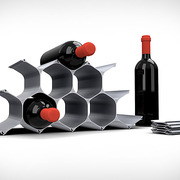
WineHive

WineHive:
The trouble with most designer wine racks is their finite size — if your collection gets too big, your primary option is to replace your current system with something larger....

Visit Uncrate for the full post.

14 Pairs of Green Sunglasses To Protect Your Peepers this Summer

14 Pairs of Green Sunglasses To Protect Your Peepers this Summer:
green sunglasses, eco-friendly sunglasses, eyewear, fashion, Malibu Tortoise, Woodwear,
Memorial Day — the unofficial start of summer in the US — is behind us, and that means longer days and brighter sunshine in the coming months. When shopping for new sunglasses, there are a couple of important factors to take into account: A good pair of shades should protect your eyes from harmful UV rays, they should look cool, and they should also look out for the planet. Beginning with the “Malibu Tortoise” ($85) by Woodwear (pictured), we’ve rounded up our top 14 favorite green sunglasses of the season. Head over to Ecouterre to take a peek at them all.

READ MORE >


Permalink |
Add to
del.icio.us |
digg


Post tags: , , , , , , , , , , , , , ,


Why Most Ideas are Worthless


Why Most Ideas are Worthless
Published on Inc.com | shared via feedly mobile

By focusing less on your next "big idea" and more on the actual execution, you'll have a better chance of building a successful new business.

Maybe it's the Facebook craze, or the warped view of entrepreneurialism that Hollywood and mainstream media have created. For ages, young and hopeful entrepreneurs have embraced the fallacy that great ideas are the root of entrepreneurial success and instant wealth. People say, "If only I would have thought of that, I'd be rich!"

Those of us who have built businesses know that success is rarely about the breakthrough idea. Clearly, a good idea is important, but it's just not the source of limitless riches. Real entrepreneurial success most often comes from hard work, risk-taking, and developing a product or solution that creates real value for customers. For example:

  • Instagram was originally a check-in app (Burbn) that evolved to become a photo app because it filled a need in that category more effectively than existing applications
  • Google was a slightly better search engine, and a platform for a number of "free" products that over time turned into an enormous profit generator
  • McDonald's thrived by making tasty, cheap hamburgers
  • Starbucks offered better quality coffee in a pleasant environment
  • Dell manufactured PCs better, cheaper, and faster than rivals

Working with CEOs, investors, and entrepreneurs to build new businesses, we've found that many initial ideas are frankly not worth much. Most eager entrepreneurs overvalue the initial idea and falsely believe that a unique idea is the key to value creation. They will even create extreme secrecy around the idea in the hopes of creating a first-mover advantage-which itself is not all that valuable in most cases.

Far more important is a rock-solid business model that creates value for a customer, especially relative to existing solutions. When the business model is battle tested through the incubation process, it becomes invincible. Very few businesses end up creating billions of dollars of value based on the initial idea - superstars such as Facebook, Apple, and Microsoft changed their business models many times before settling on a scalable solution.

When entrepreneurs come to us for help on their "killer idea," here's the advice we give:

Don't be afraid to share your idea. The value is not in the idea, but in the execution. Experienced entrepreneurs, business owners, and investors can give you valuable advice. If your idea is any good, people will steal it. Your job is to execute better than them. 1. Stop perfecting the idea, and get out in front of customers.

The business you develop through a test and learn approach will be worth multiple times more than your original idea. 2. Don't focus on things that don't exist.

Instead, look at existing solutions and figure out ways to create more customer value than what those solutions offer. 3. Positively differentiate yourself from the competition.

Most products can't be all things to all people. A differentiated product will attract a segment of customers that value different things. An innovative start-up is almost always advantaged when chipping away at a market leader if they can offer something different that appeals to a small group of customers.

Turn your idea into positive action, and build real customer value. Then, just maybe, you will be able to turn the next "big idea" into a successful business

Share your thoughts on evaluating new business concepts with us at karlandbill@avondalestrategicpartners.com.


Sent from my iPhone

Build a Product Customers Will Buy


Build a Product Customers Will Buy
Published on Inc.com | shared via feedly mobile

You can't live without your product--but what about your customers? Five tips to ensure you're selling something people want.

Where do most entrepreneurs get inspiration for new products? By thinking of items they themselves wish they could buy. This is why there are so many new products directed at new college grads, and relatively few targeted to folks in nursing homes.

Launching a company to create a product you want to buy is a great idea. You're likely to put your imagination, energy, and passion into it, and you'll always be more effective at selling something you yourself would willingly pay for.

But you can hit trouble if you make the mistake of building the product to your own specifications. That's what happened to Eric Warnke and Mark Fossen, founders of the companies Surreal WiFi and Backup Box, both based in Edmonton, Canada. Surreal WiFi is three years old and deploys and manages hotspots in restaurants and businesses at 125 locations throughout Canada. Backup Box allows customers to back up Web servers to services such as Dropbox and (shortly) Google Drive. Launched in March, Backup Box already has more than 2,000 users--and counting--and has helped back up about 6 million files.

"With Surreal WiFi, we accidentally built a product for ourselves and not for our customers," Warnke says. "Backup Box benefited from the lessons we learned." So can you:

1. Solve problems, not pain points.

"A lot of startups create business models around easing a pain, but it's a tiny pain--not something people are willing to pay for a solution to," Warnke says. Instead, he advises, "Actually solve a problem."

Case in point: Rather than seeing itself as a hotspot provider, Surreal WiFi considers itself a marketing company. Its real benefit to customers is not wireless Internet access for their customers, but rather the opportunity to market their products via splash pages and email sign-ups. "Not having Wi-Fi is kind of a pain, and it's easily solvable," Warnke says. "How to get people to stay longer, and how to collect email addresses is a problem restaurant owners consider on a daily basis."

2. Simpler is better.

Originally, Warnke and Fossen loaded up Surreal WiFi with all the features they themselves would want, but they soon realized their sophisticated technological tastes were different from those of the typical restaurant owner. "We started out with network options where you could set a router to transmit power or change the channel it broadcasts on," Warnke says. They soon learned that restaurant owners didn't need all these options, and the more functionality their product had, the easier it was to make a mistake that might disable it.

The moral of the story is to start with the fewest possible features and plan to add more as needed. That's a lot better than starting with too many and needing to take some away.

3. The customer isn't always right.

"One of the biggest things people told us with Surreal Wifi was that they needed the ability to block individual users, to prevent them from downloading movies and watching all day long," Warnke says. As it turned out, that problem never materialized. "Now I tell them, 'If you ever have that problem, call me and I'll give you that feature.'" No one ever has.

4. Sell it before you build it.

Inspired by the start-up Buffer, the partners began selling Backup Box before they had a product to sell. They knew from discussions on Dropbox user forums that customers were eager for an FTP interface that would work with the service. But they didn't know which features customers would want, or how much they'd be willing to pay.

To find out, they created a website for Backup Box describing the service and offering a variety of plans ranging in price from free to $99/month, with and without limits on data transfers per month, the ability to schedule transfers in advance, and other features. Once someone clicked on a plan, the site would come up with a page explaining the product was not ready yet, and inviting the user to leave an email address. That gave them detailed information that helped them create plans and pricing later on.

5. Don't listen to your friends.

In fact, you may not want to even tell them about your product idea. "When I created the landing page for Backup Box, I didn't tell the large mailing list of entrepreneurs I was on, or my friends and family," Warnke says. "I knew they'd go there and put in their email addresses because they'd want to support me." And that was the last thing he wanted. "Your friends and family can't provide validation for your product."


Sent from my iPhone

When Overnight Success Takes Years: 4 Tips


When Overnight Success Takes Years: 4 Tips
Published on Inc.com | shared via feedly mobile

We all love overnight success stories. But for most entrepreneurs, the road is a lot rockier.

It's easy to love success stories like Instagram or Youtube, but what if your startup is growing much more slowly? What if it's taking you years, not weeks or months, to reach millions of people?

Allen Lau, co-founder of Wattpad, a cloud-based community of authors and readers, bootstrapped for five years before raising his Series A financing with investors such as Union Square Ventures. Here's his advice:

Pick the chicken or the egg. Early on, Wattpad faced the classic chicken and egg conundrum: With no users, nobody was writing content. But with no content there was nothing to engage visitors, so they left. Wattpad had to choose - did they need users, or did they need content? They went for content, and uploaded 20,000 stories from Project Gutenberg, a free source for works in the public domain. The content wasn't unique or exclusive, but at the time Wattpad provided a novel way for consumers to access that content: on mobile devices. That helped get their user base growing.

In hindsight, the decision to pursue content before users may appear obvious, but at the time it was hardly certain, especially in the face of pressure to chase users and drive dramatic early growth. Lau was able to resist that impulse for two reasons:

  • He recognized that product was the content itself, not the app
  • If he pursued users before he had enough to offer, he might drive a short- term spike in downloads, but he'd have to deal with immense churn. And once a user has abandoned a product, it's almost impossible to re-engage them.

Focus on differentiation. From the start, Lau's core strategy was to enable users to access content on mobile devices. "Keep in mind this was 2006, before Apple launched iTunes or Amazon launched the Kindle. The ability to read content on mobile devices was a big differentiator," says Lau. His team worked feverishly to make sure its content was accessible on as many devices as possible. The work paid off: Back in 2006, if a you were to search for "mobile" and an author such as Charles Dickens, Wattpad would have been the first result.

Listen to users. They don't lie. For consumer products, Lau says, "It's pretty obvious when users embrace a feature. If usage isn't trending up after an initial spike of adoption within one to two weeks of launch, we kill the feature and move on. You can't afford to push a [floundering] feature for nine months; you'll run out of cash." Lau recommends tools like Flurry and Google Analytics that help measure a feature's initial traction, and can help your startup begin to make disciplined, data-driven development decisions.

Beware venture funding. Organic growth takes a long time, but investors need to generate returns quickly. "The traffic was growing month over month. It just wasn't generating enough cash to feed my family, let alone please any potential investors," says Lau. If Wattpad had had venture backing early on, it would have had a shorter time frame in which to generate returns. Instead, Lau and his co-founders were able to fund the business by running a mobile advertising startup during those early years.


Sent from my iPhone

Woo the Media: 6 PR Tricks


Woo the Media: 6 PR Tricks
Published on Inc.com | shared via feedly mobile

Building relationships with the press can feel a lot like dating. Follow these rules to develop a real connection.

It feels good, doesn't it? Your name in print, broadcast or online. There's something about the instantaneous pleasure that a positive PR story brings.

But the reality is that the immediate gratification you're feeling took someone--a publicist, agency, you ... and, of course, a journalist--a lot of time and effort.

Building relationships with the press isn't so different from building any other relationship--and in fact, it can feel a lot like dating. So whether you're going it alone or using a publicist, PR firm, or internal specialist, you should know a few important rules for creating and caring for your media relationships.

1. Be monogamous.

One misconception is the more, the better. Not so when it comes to pitching a story. Sending the same email to the masses is like hanging out in a rocking chair: it gives you something to do, but you won't get very far. Instead, target your story to the perfect reporter.

2. Woo them personally.

Media professionals do their fair share of research before developing a story--and so should you. Do your homework; see what your ideal contact is already writing and/or talking about-;and make sure you understand the reporter or producer's point of view. Then be sure to woo your contact with a tie to his or her existing editorial interests.

3. Flirt online.

Interested in a particular journalist or media outlet? Follow your contacts on Twitter. This is an opportunity to see what they are up to, learn what fires them up, and interact in a meaningful way.

4. Build connections.

Align yourself with recognizable partners, such as celebrities or experts. This is one way to get quick attention; you can also leverage the resources of your partners. But remember: Even when celebrities are involved, you still need to tell a unique story to gain and keep the respect of your contact.

5. Get past 'hello.'

Craft sexy (but not inappropriate!) messaging that will immediately attract your contact. Start with your subject line: Media professionals receive an onslaught of communication and your emails need to make it past all of the other appealing messaging.

6. Develop mutual commitment.

Once you've developed a relationship, continue to follow up with timely and relevant stories. Media professionals like having an arsenal of experts they can continually count on. These relationships can be mutually beneficial for years to come.


Sent from my iPhone